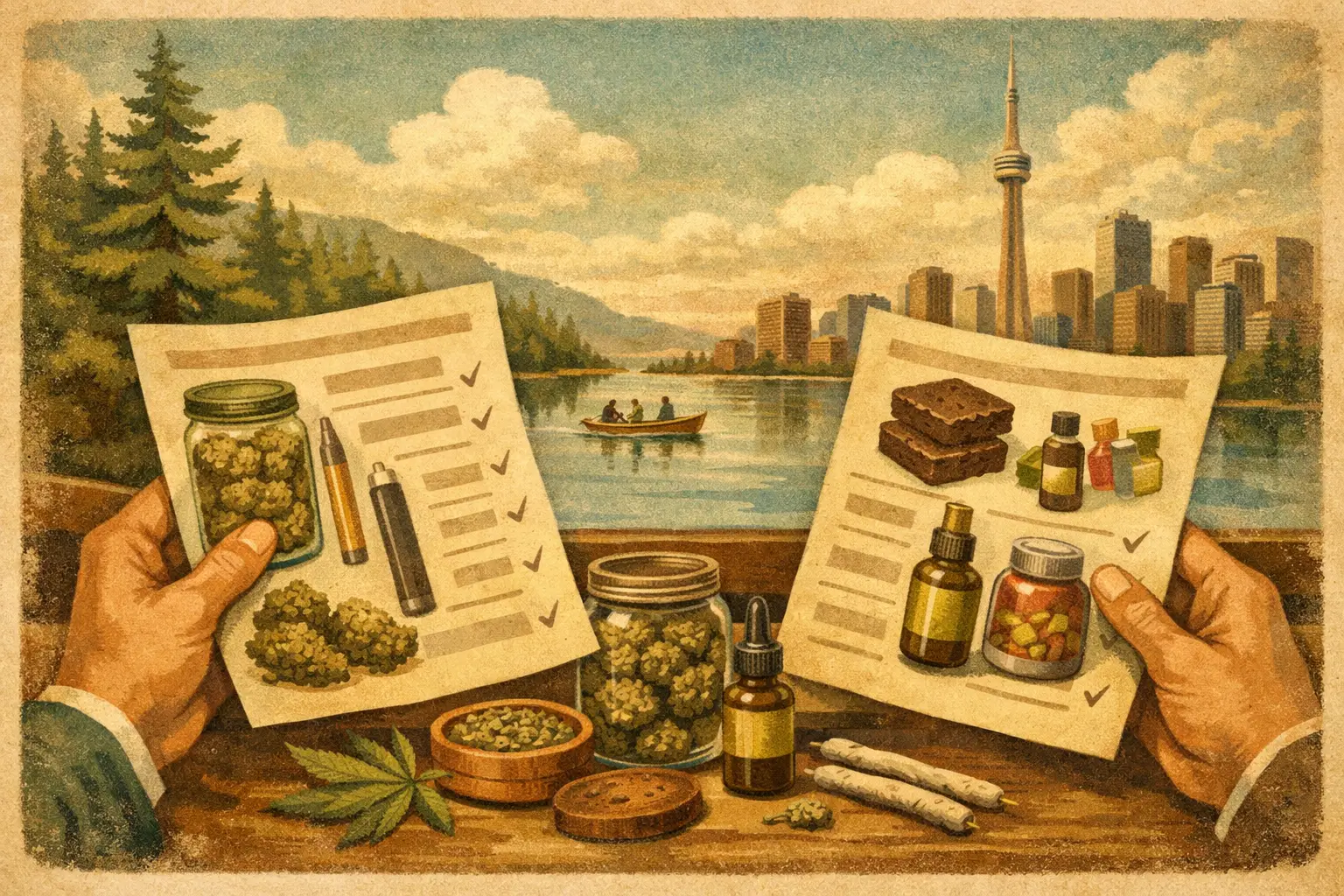





A 28% flower product and a 10 mg edible do not belong in a simple “stronger versus weaker” comparison. They use different units, are consumed differently, and can produce very different experiences. Knowing how to compare THC labels helps Ontario consumers shop legal cannabis more deliberately, whether they are choosing a pre-roll for the evening or an edible with a clearly measured dose.
THC information on legal cannabis packaging is useful, but it is not a complete prediction of how a product will feel. Read the format, the units, the package size, and the cannabinoid profile before treating a large number as the deciding factor.
Start with the product format
The first rule is simple: compare like with like. THC percentages are most useful when comparing dried flower, pre-rolls, and some concentrates. Milligrams are the practical unit for edibles, beverages, oils, capsules, and many vape products.
A flower label showing 25% THC does not mean the product contains 25 mg of THC per package. It means approximately 25% of the product’s weight is THC-related cannabinoid content, expressed as milligrams per gram. An edible labelled 10 mg THC, by contrast, states the measured amount of THC in the edible or package.
This distinction matters because inhaled cannabis and ingested cannabis have different onset times and durations. A 10 mg edible may be manageable for one experienced consumer and too much for a first-time buyer, while a flower product with 20% THC can be easier to pace one inhalation at a time. The label gives you a starting point, not a direct cross-category conversion.
How to compare THC labels by unit
Legal cannabis labels commonly present THC as a percentage, milligrams per gram, milligrams per unit, or milligrams per package. Use the unit that matches the format.
Flower and pre-rolls: use % THC or mg/g
For dried flower, 1% THC is broadly equivalent to 10 mg/g. That means a flower labelled 20% THC is approximately 200 mg/g THC. A product at 27% THC is approximately 270 mg/g.
This makes flower comparisons straightforward. If two 3.5 g jars are both within the same freshness range and product type, a 27% THC flower has more THC by weight than a 20% THC flower. It does not automatically mean it will be more enjoyable, less harsh, or better suited to your plans.
For pre-rolls, check both the THC percentage and the weight of each pre-roll. A 0.5 g pre-roll at 20% THC contains less total THC in the roll than a 1 g pre-roll at the same percentage. If you are trying to control intake, the smaller pre-roll may be the more practical purchase even when the percentage is identical.
Edibles and beverages: focus on milligrams per serving
For edibles, the most useful number is THC in milligrams per individual piece or serving. Also check the total THC in the package. A package may contain several gummies, each with an equal share of the listed total.
For example, a package with two gummies and 10 mg THC total usually provides 5 mg per gummy. A single beverage labelled 10 mg THC provides the full amount in one container. The total package amount may match, but the ability to divide the dose is different.
New or occasional consumers often benefit from starting with a lower amount, such as 2.5 mg THC, then waiting long enough before taking more. Edibles can take 30 minutes to two hours or longer to take effect, depending on the person, food intake, and product. Taking another dose too early is one of the most common avoidable mistakes.
Vapes, oils, capsules, and extracts: check concentration and total volume
Vape cartridges may show THC as a percentage or mg/g, along with the cartridge size. A 1 g cartridge at 80% THC contains more total THC than a 0.5 g cartridge at 80%, even though the concentration is the same. Compare cartridge size before assuming two similarly labelled vapes offer equal value or equal duration.
Oils and capsules are usually easier to compare because labels identify THC in milligrams per millilitre, per capsule, or per activation. If an oil contains 10 mg THC per mL and the bottle has 30 mL, the bottle contains 300 mg THC in total. For controlled use, the per-mL or per-capsule figure matters more than the large total on the package.
Concentrates can carry very high THC concentrations. A high number may suit consumers who already understand their tolerance and equipment, but it is not necessarily a sensible starting point. Small amounts can be potent, and a higher concentration leaves less room for imprecise dosing.
Read THC and total THC correctly
You may see both “THC” and “total THC” on Canadian cannabis labels. These are related but not identical measurements.
THC is the active cannabinoid measured at the time of testing. Total THC accounts for THC plus the potential THC that can result when THCA is heated. Because smoking, vaping, and some forms of processing involve heat, total THC is often a more relevant comparison point for inhaled flower and pre-rolls.
When comparing two flower products, use the same measurement on both labels. Do not compare one product’s THC figure with another product’s total THC figure and assume the numbers mean exactly the same thing. The difference may be modest, but consistency produces a fairer comparison.
Labels may also show a range rather than one exact number. Legal cannabis is an agricultural product, and cannabinoid levels can vary by lot. The package in front of you is more relevant than an older online menu listing or a general product description.
Do not shop by THC alone
THC is only one part of a product’s profile. Two flower products at 24% THC can smell, taste, and feel noticeably different because of terpene content, minor cannabinoids, cultivation conditions, moisture, and freshness.
Terpenes are aromatic compounds that influence flavour and may shape the character of the experience. A product with myrcene, limonene, caryophyllene, or pinene may appeal for reasons that a THC percentage cannot capture. If a legal retailer provides terpene information, use it alongside THC rather than as a replacement for it.
CBD also changes the comparison. A balanced THC:CBD product may be a better fit for someone who wants a less THC-forward option than a high-THC product with little or no CBD. Check whether the label lists CBD and total CBD, then compare the ratio. A product with 10 mg THC and 10 mg CBD is materially different from one with 10 mg THC and negligible CBD, even though the THC amount is the same.
Freshness matters, particularly for flower and pre-rolls. Check the packaging date where available, packaging integrity, and storage guidance. A slightly lower-THC product that is fresh and well kept can be a better purchase than an older product with a higher headline number.
Compare total THC, price, and usable servings
Price comparisons are more accurate when you look beyond the package price. For flower, calculate the cost per gram, then consider the THC range, package date, and format. For edibles, compare cost per milligram of THC only after confirming the serving size and your expected use.
A low cost per milligram is not always the best value. If an edible is difficult to divide or a concentrate is stronger than you are comfortable using, some of that THC may not be practically useful to you. Convenience, dose control, and the likelihood of finishing the product responsibly are part of value.
When shopping menus, confirm whether the stated THC figure refers to the current lot. Licensed Ontario retailers can help clarify product size, format, and the information printed on the package, but they cannot determine your personal tolerance or guarantee a particular effect.
A practical label check before checkout
Before buying, identify the format first, then locate the unit: percentage or mg/g for flower and inhalables, milligrams per serving for edibles, and concentration plus volume for oils, vapes, and extracts. Check total THC as well as per-unit THC, especially when a package contains multiple servings.
Next, compare the same measurement across similar products. Look at CBD, terpene details when available, package size, and packaging date. Finally, choose a format and amount that you can pace comfortably. Avoid driving, operating equipment, or mixing cannabis with alcohol, and keep all cannabis products secured away from children and pets.
The most useful THC label is not the one with the biggest number. It is the one that lets you understand what you are buying, dose it with confidence, and choose from Ontario’s legal retail market according to your own experience and plans.